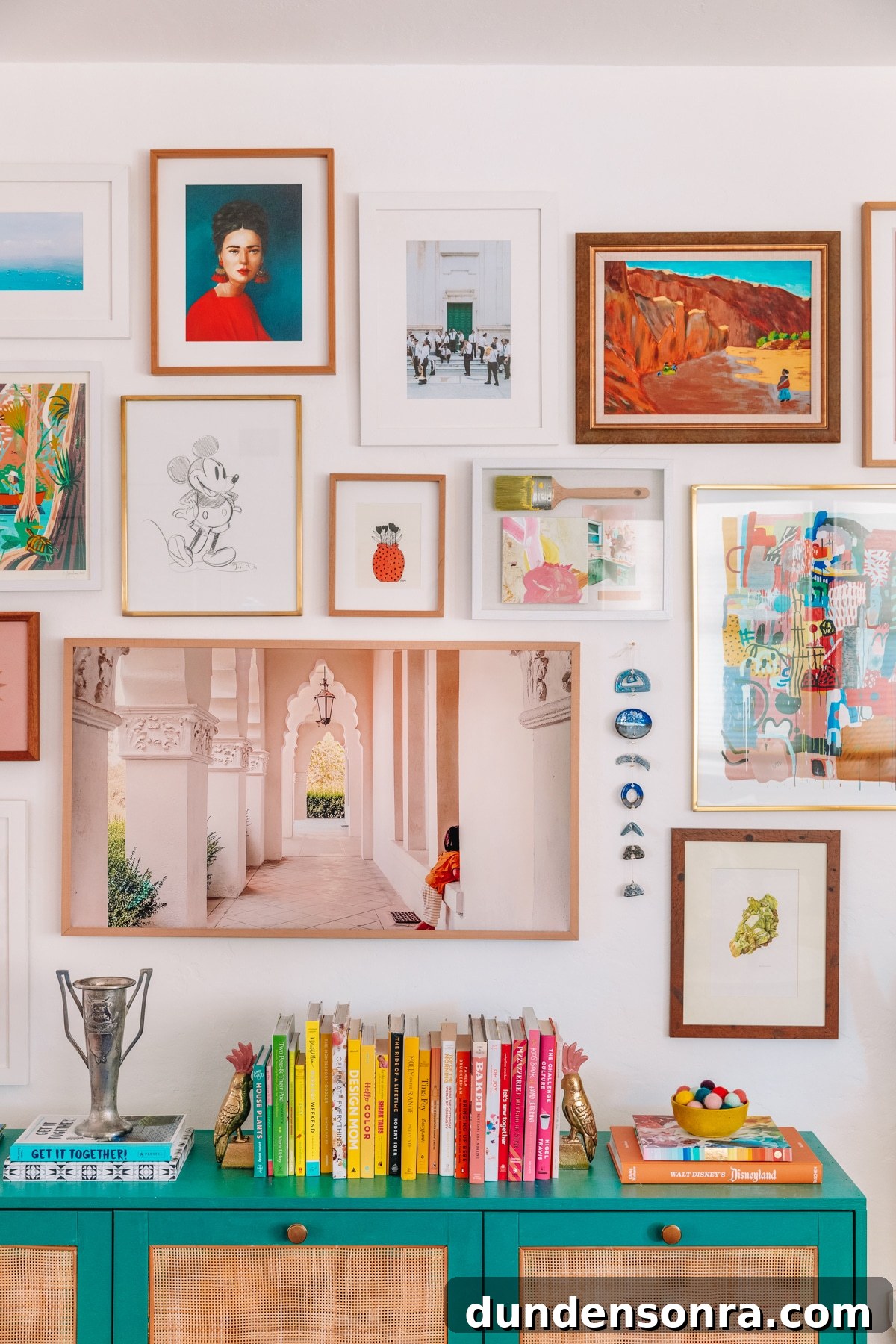
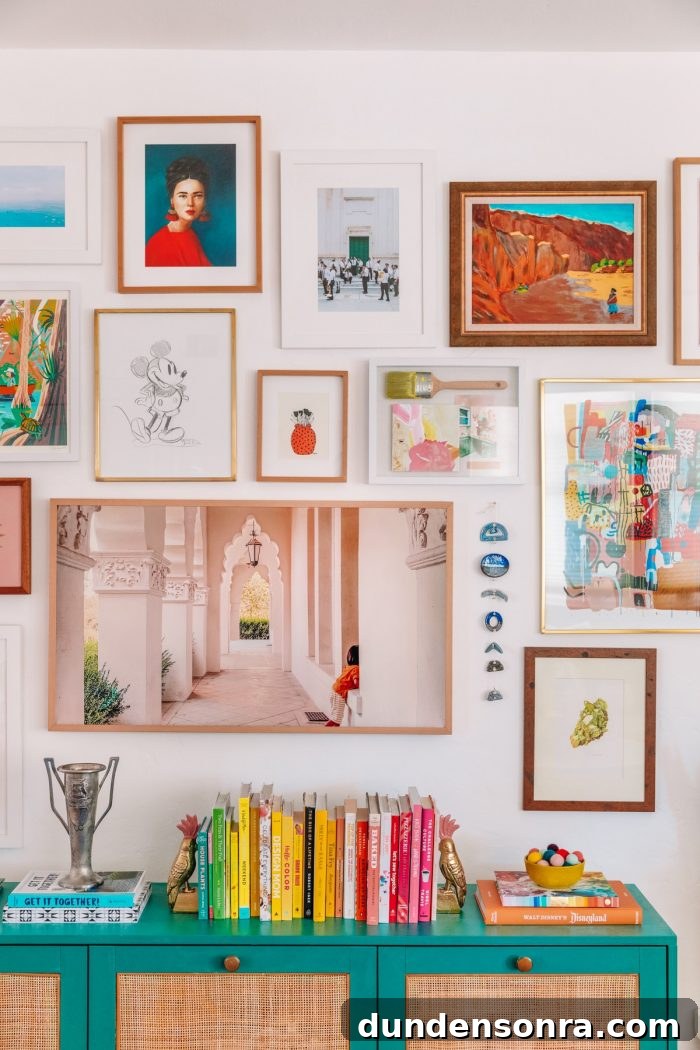
A gallery wall is one of my favorite ways to display collected art, family photos and meaningful mementos. It brings warmth, personality and a focal point to any room and often sparks conversation. Below are practical tips for selecting and arranging pieces, planning layouts and hanging your finished display.
Starting a gallery wall can feel like a “chicken-and-egg” problem: do you build around a treasured collection or begin with a blank wall and shop for pieces to fit it? There’s no single correct approach—gallery walls are personal and adaptive. Use these guidelines as a flexible roadmap rather than strict rules.
This guide focuses on non-symmetrical gallery walls—mix-and-match frames, various sizes and styles—which are especially approachable if you’ve gathered artwork over time.
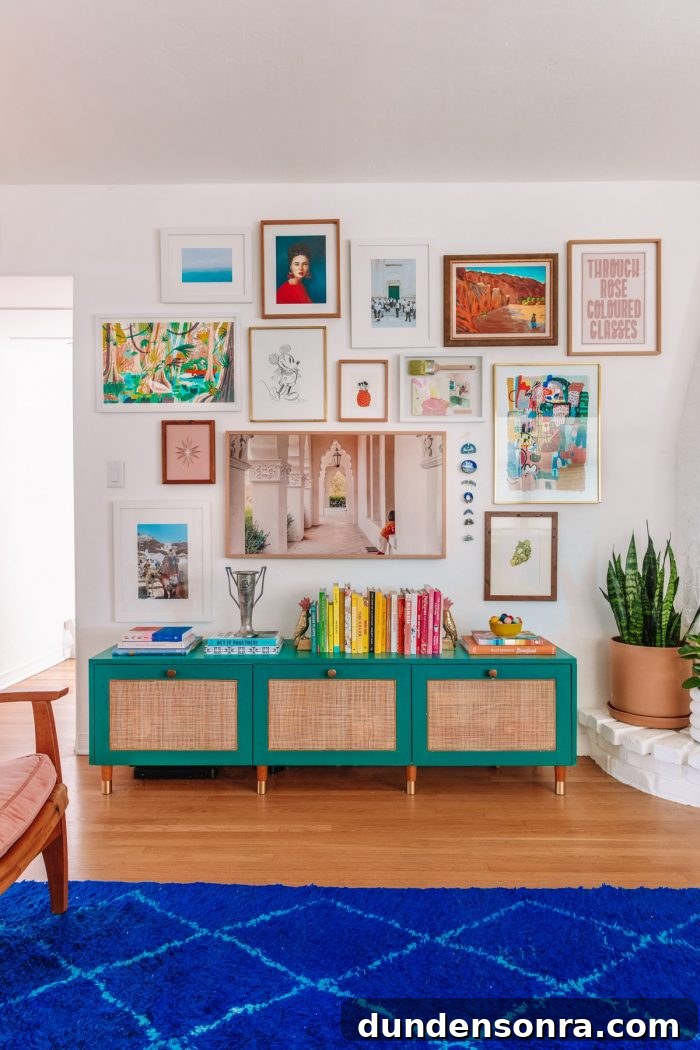
Photo by Jeff Mindell
Table of contents
- First Thing’s First, There’s Always An Exception
- Selecting + Pairing Your Art
- How To Include Family Photos
- How Should I Frame My Gallery Wall Art?
- 3D Objects as Gallery Wall Art
- 3 Methods for Planning Out Your Gallery Wall
- How To Lay Out Your Art
- How To Hang A Gallery Wall
- Renting? Hang A Gallery Wall with NO Nails!
First Thing’s First, There’s Always An Exception
I’ve seen gallery walls in every style—dense grids, airy spreads, and eclectic mixes—and they can all work beautifully. For every guideline here there are occasions when breaking the rule makes a stronger design. Remember: your gallery wall should reflect your taste and collection.
This post highlights tips that make mixed, asymmetrical galleries easier to design and hang, which is helpful if your pieces vary in size, medium and frame finish.
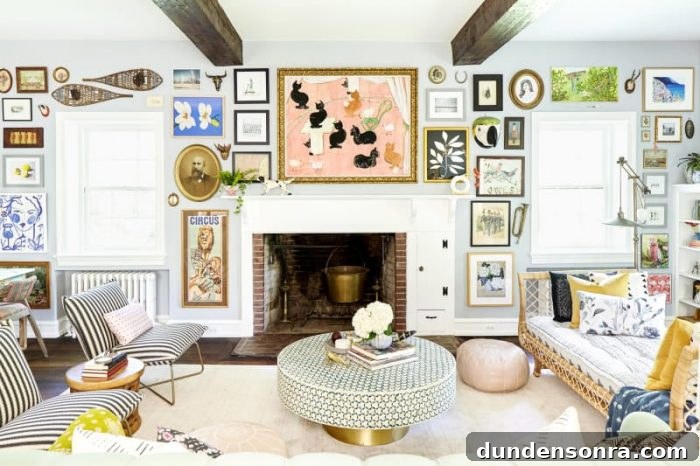
Photo by Kyle Smith Born, Designed by Michelle Gage
Selecting + Pairing Your Art
Whether you’re curating from pieces you already own or buying new prints, follow a few simple rules so the wall reads as a cohesive composition.
Repeat colors at least 2–3 times. If you’re buying art, choose a palette and stick to it. If you’re mixing existing pieces, aim for each piece to share one or two colors or tones with at least two other works. This repetition helps the whole arrangement feel intentional.
Vary art styles. Mix photographs, abstracts, portraits and line drawings to create depth and interest. As with colors, try to have each style represented multiple times so the mix feels balanced.
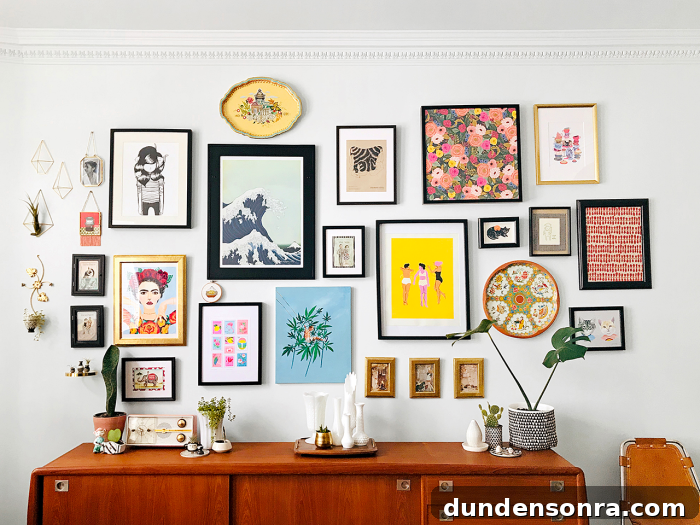
Photo via Chatelaine/Sun Ngo
Mix sizes and orientations. Choose one to three larger anchor pieces, then fill with medium and small works. Avoid only vertical or only horizontal pieces—a mix creates a more dynamic layout.
Make it personal. Include meaningful items—kid art, letters, class photos or other mementos—to add warmth and narrative to the wall.
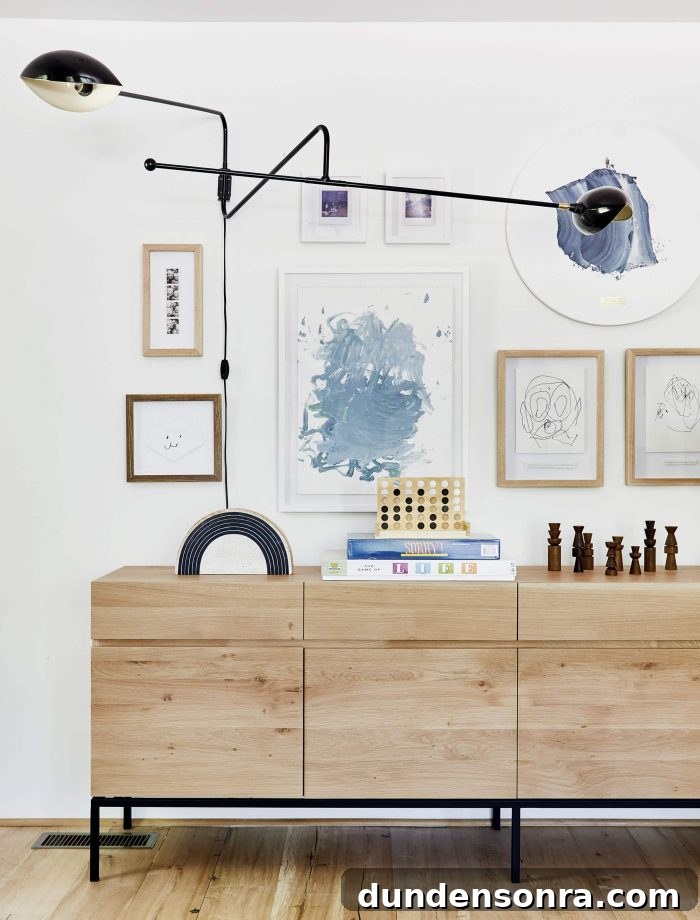
Photo via Emily Henderson
How To Include Family Photos
Family photos can sit comfortably within an art-focused gallery with a few mindful choices.
Consider black-and-white photos. Converting family photos to black-and-white can unify disparate styles and help them blend with artwork that carries monochrome elements.
Match photo tones to your palette. If you prefer color, choose images with tones that echo the wall’s art—warmer or cooler photos depending on the dominant palette.
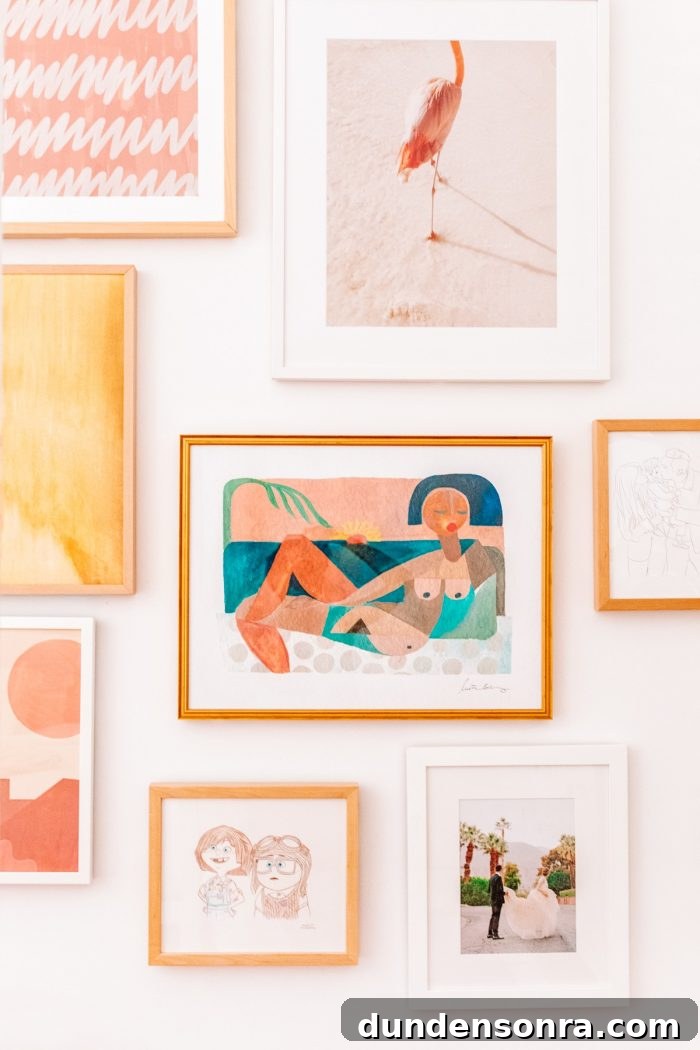
Photo by Jeff Mindell
Favor candid shots. Candid images often feel more in tune with an eclectic gallery, though posed photos can work if styled to match the palette and framing.
Use wide mats. Placing photos in frames with generous mats gives them a modern, gallery-like presentation. For a 5×7 photo, consider an 11×14 frame to create that mat margin.
Group photos creatively. Frame multiple photos together or hang a series side-by-side to form a cohesive piece within the larger wall.
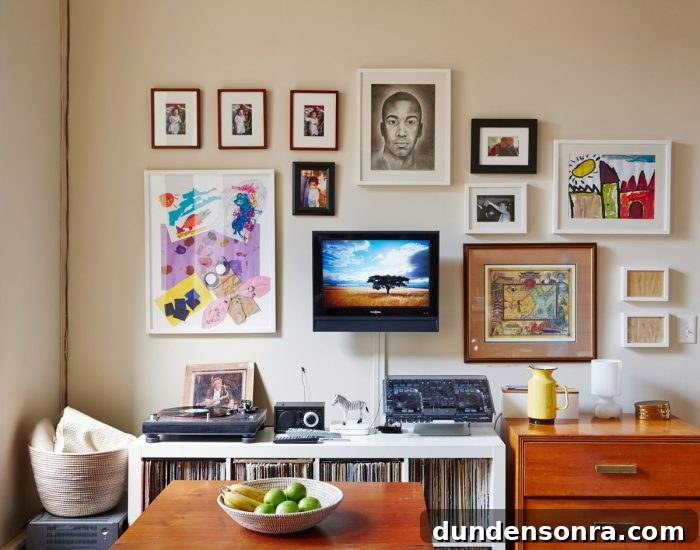
Photo via D. Bryant Archie/Corner Compass
How Should I Frame My Gallery Wall Art?
Mixing frame finishes and styles usually produces the most layered, collected look.
Mix up to three finishes. A practical combination is wood (warm tone), metal (brass or silver) and a neutral (black or white). Make sure each finish appears across multiple pieces to maintain balance.
If you use one finish, vary styles and widths. Uniform color with varied frame profiles still feels curated without the struggle of sourcing exact matching sizes.
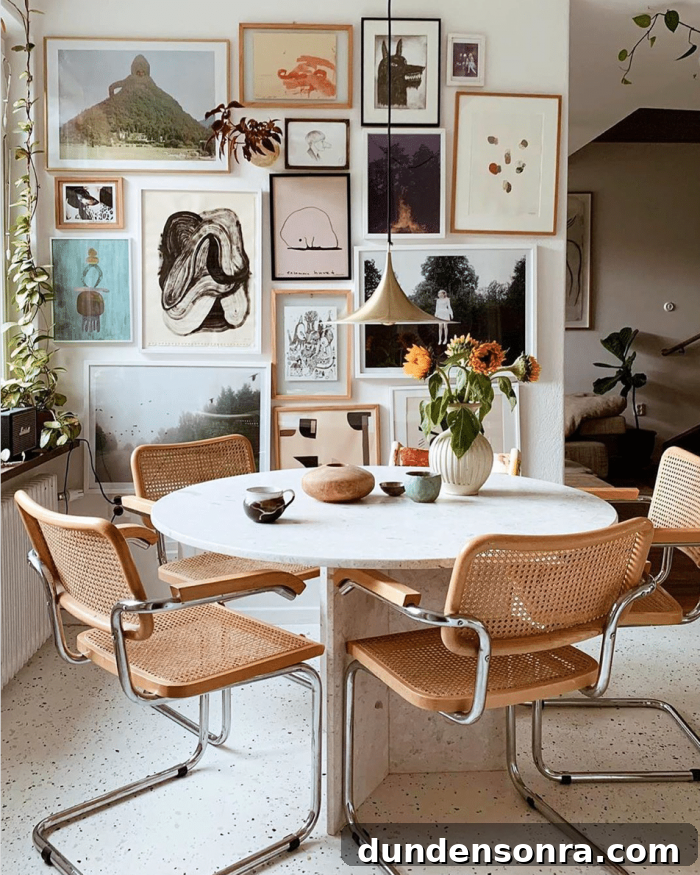
Photo via @ettrumtill
Use store frames and custom mats for savings. Buying standard frames and having custom mats cut is usually far cheaper than full custom framing; mats can often be created for $10–$30.
Repurpose framed art for large frames on a budget. Remove the existing print from an inexpensive store-bought framed piece and replace it with your work.
Have fun with color in kids’ rooms. Bright frames and poster-style hangers make playful, kid-friendly galleries.
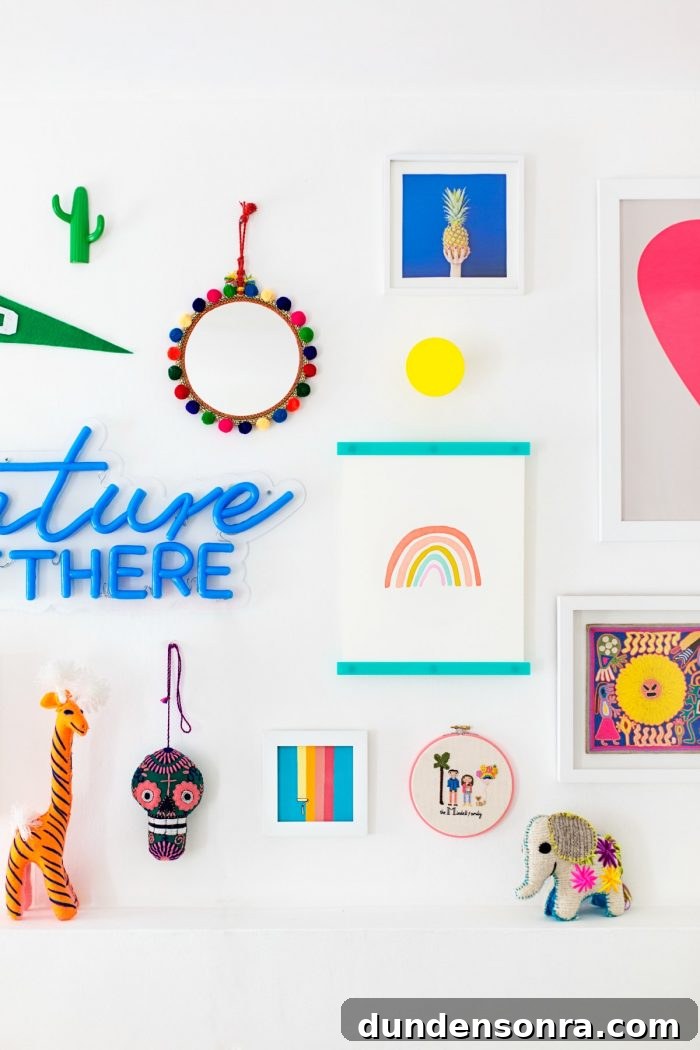
Photo by Jeff Mindell
3D Objects as Gallery Wall Art
Dimensional objects add texture and break up flat framed pieces. They’re also useful for filling awkward gaps.
Good options include ceramic wall hangings, plush charms, embroidery hoops, woven baskets, mirrors, sconces and small neon lights.
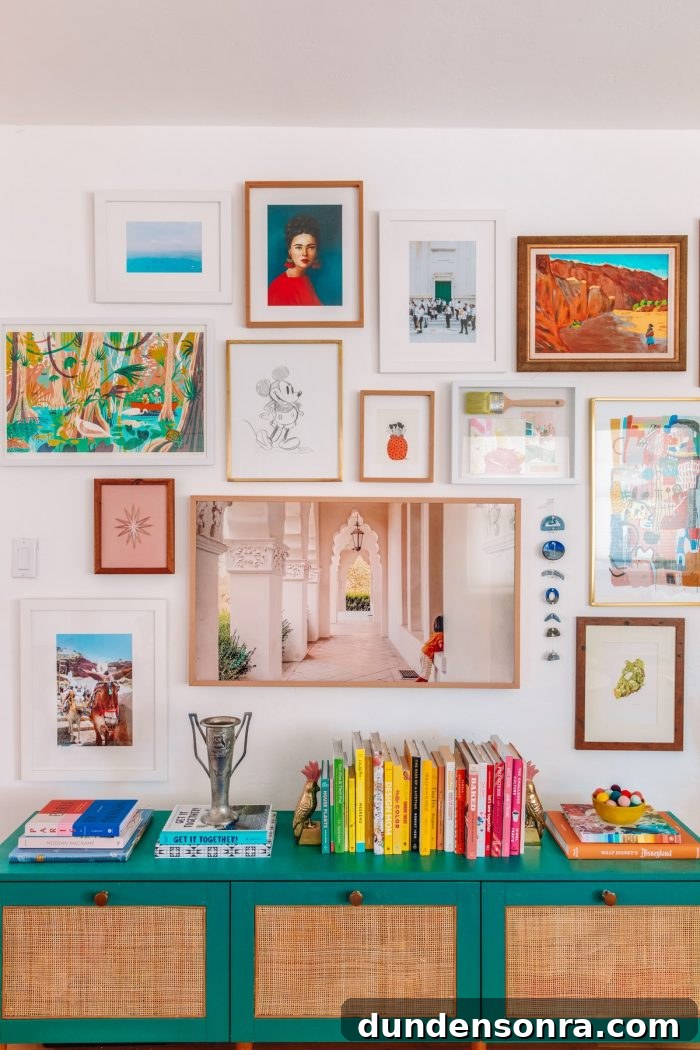
Keep in mind that some dimensional pieces require visible hooks or hardware. Choose hanging hardware you’re comfortable displaying, such as decorative hooks or brass nails, and plan for that when arranging the layout.
3 Methods for Planning Out Your Gallery Wall
Before hammering nails, plan your layout. You can work digitally, on the floor or directly on the wall. Each method has advantages depending on your comfort level and the pieces involved.
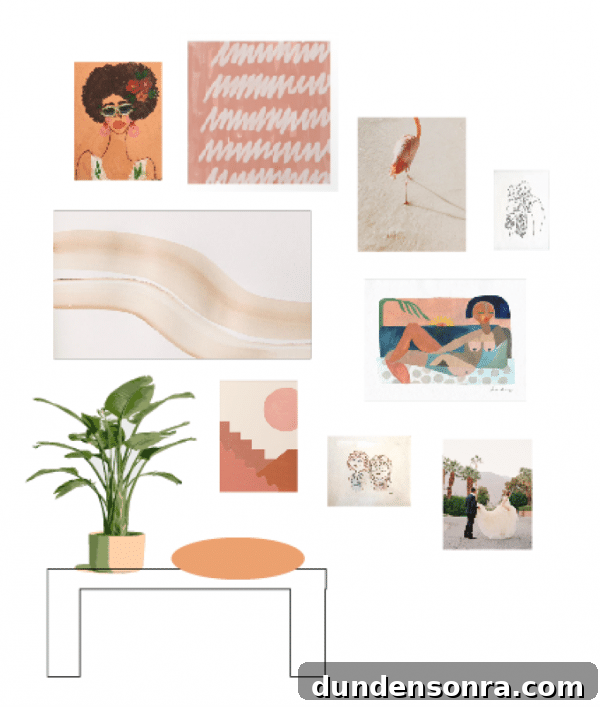
Digitally: Useful when purchasing pieces to see how they will scale and fit. Use tools like PowerPoint, Keynote, Google Slides or any design program to mock up sizes and placement. For quick checks, drag and drop images and eyeball proportions; for precision, scale each image to size.
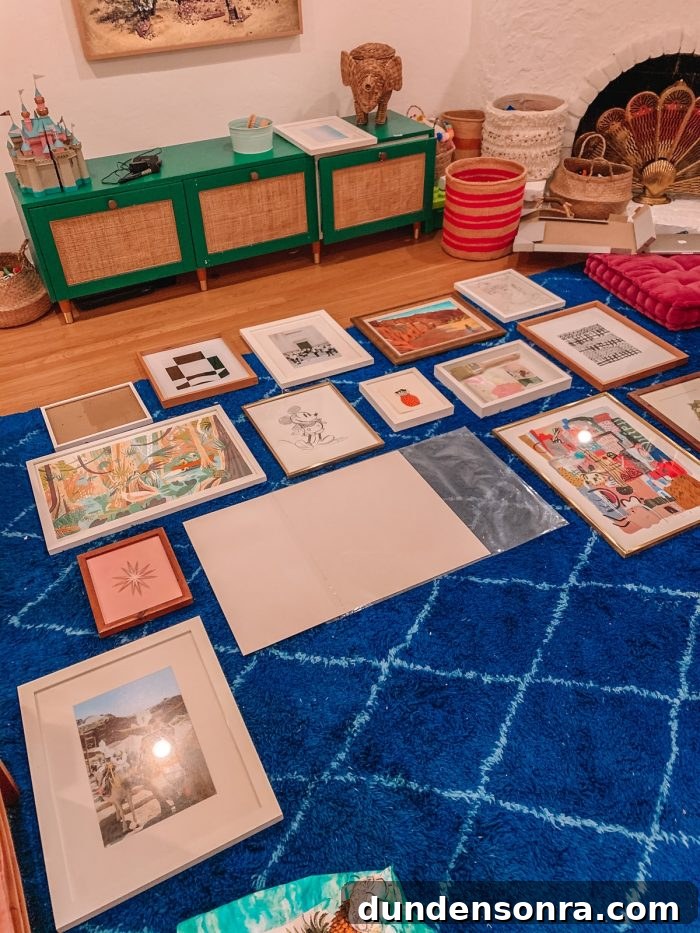
On the floor: This is the simplest no-cost approach. Measure the wall, mark the same rectangle on the floor and arrange framed pieces within that footprint. Use tape or books to define corners and include cutouts for fixed elements like a TV.
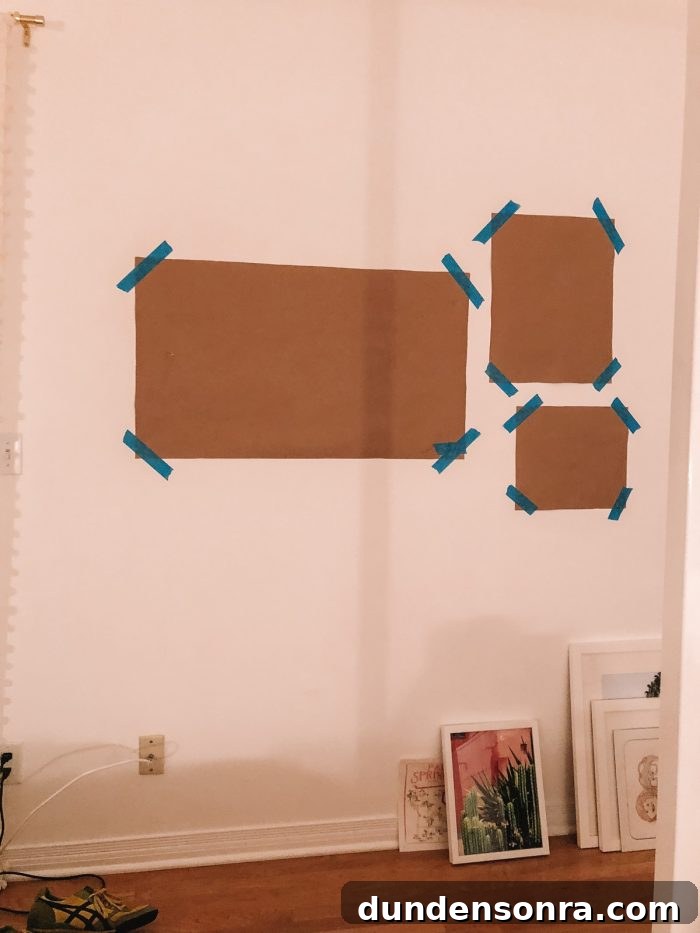
On the wall: Cut kraft paper or grocery bag paper to match each frame size, tape the templates to the wall and try arrangements without nails. This method is hands-on and accurate but more time consuming.
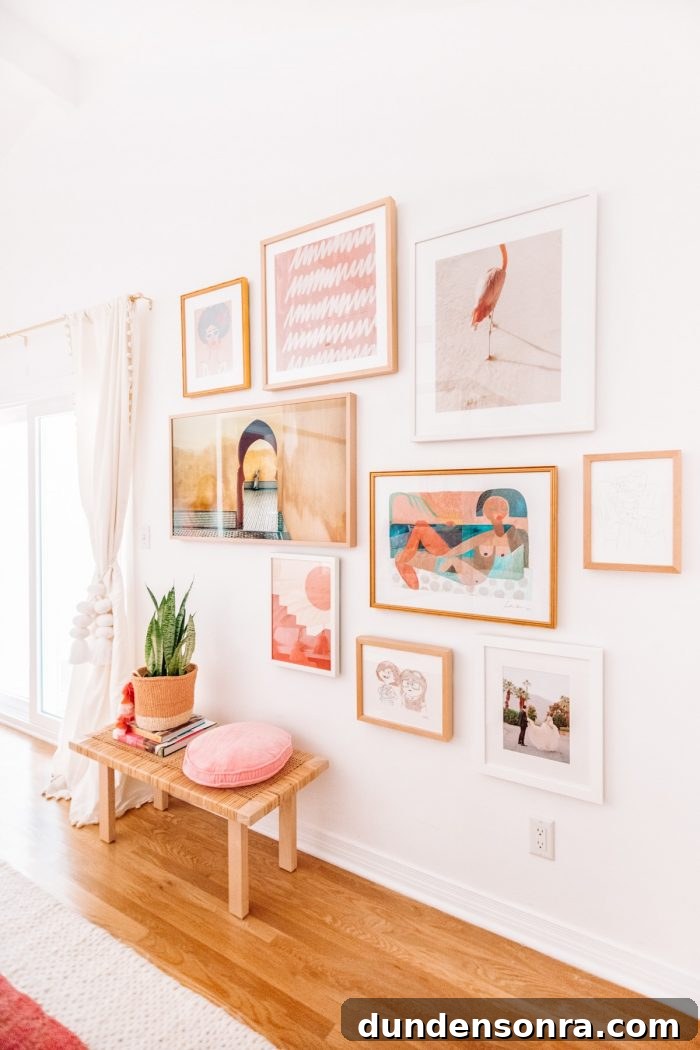
Photo by Jeff Mindell
How To Lay Out Your Art
Apply these guidelines while planning so the final hanging feels balanced and intentional.
Place your largest anchor piece(s) first. Anchor pieces often look best slightly off-center. Build outward from them by filling in with medium and small works.
Mix horizontal and vertical pieces. Avoid clustering pieces of the same orientation together unless you’re creating a deliberate grid.
Spread similar sizes, colors and styles throughout. This keeps the eye moving and prevents visual clumping. If several identical pieces work together, embrace a small triptych or grid within the larger arrangement.
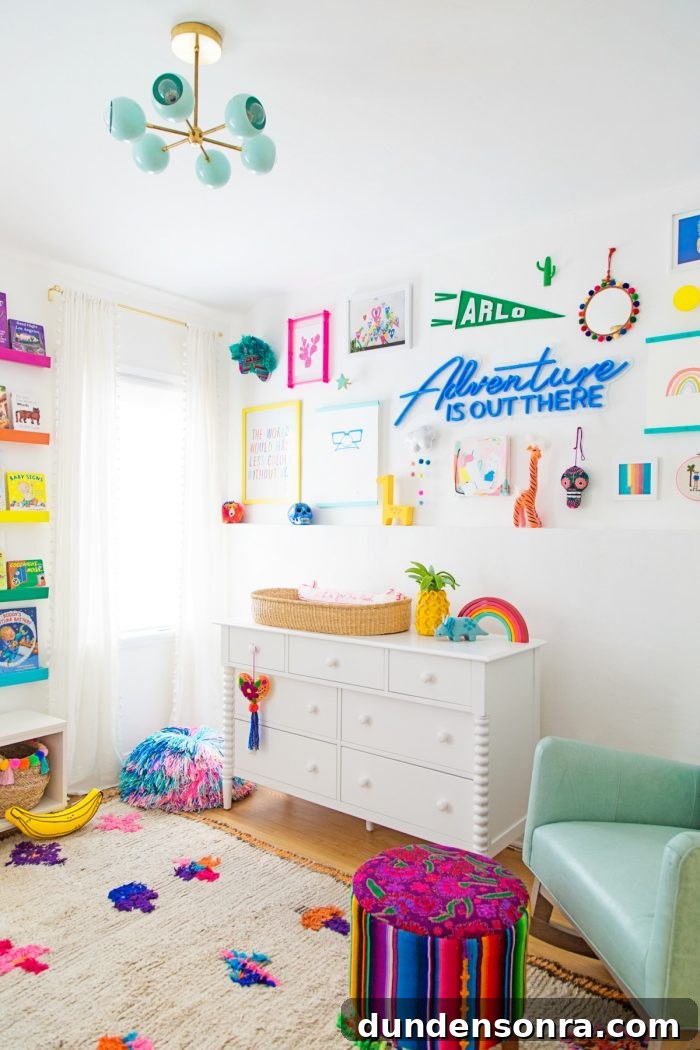
Photo by Jeff Mindell
Vary frames across the wall. Distribute frame finishes and styles so similar frames aren’t clustered together.
Don’t obsess over perfect spacing. Slightly inconsistent spacing often looks more relaxed and collected. Use dimensional objects to fill awkward gaps and allow some negative space to breathe.
How To Hang A Gallery Wall
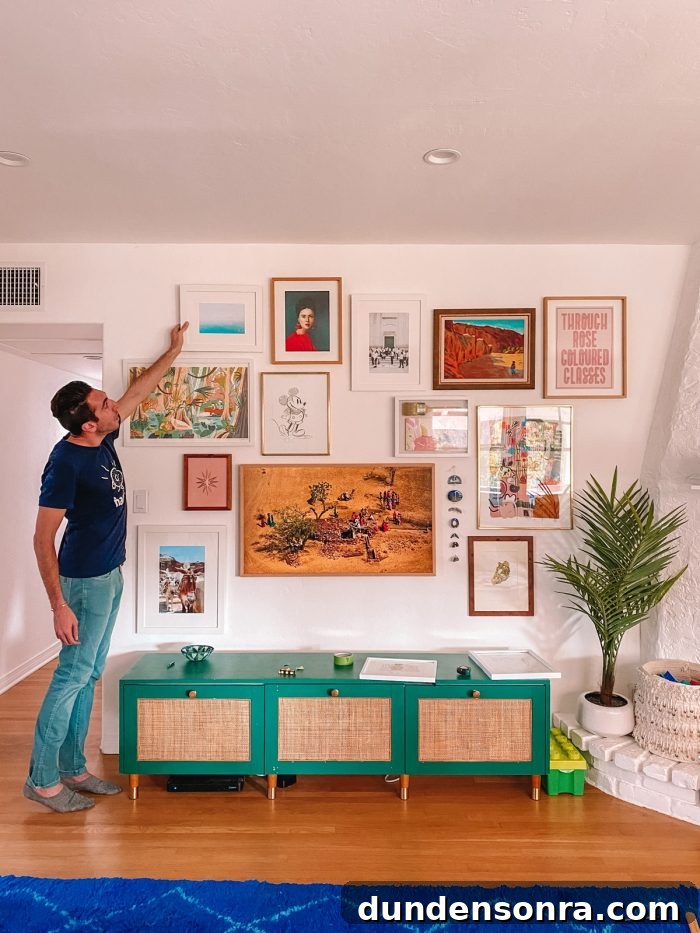
Assembling an asymmetrical wall is forgiving—allow room for minor adjustments and enlist help to speed the process.
Lay out art on the floor first in the same arrangement you plan to hang.
Begin with the anchor piece. Start near the middle (not the exact center) of your marked area and work outward from there. If there’s a fixed line like a dresser top or TV, start at that edge to avoid spacing issues later.
Have one person hold a piece while another marks the nail or hook location with a pencil. Use photos taken from a distance to confirm placement in 2D before committing.
Hang pieces adjacent to already hung items. Build the installation incrementally rather than jumping across the wall and risking running out of space mid-way.
Choose a standard spacing as a guideline. Pick a comfortable gap—tighter for a dense look, wider for airier displays—but don’t be rigid about it.
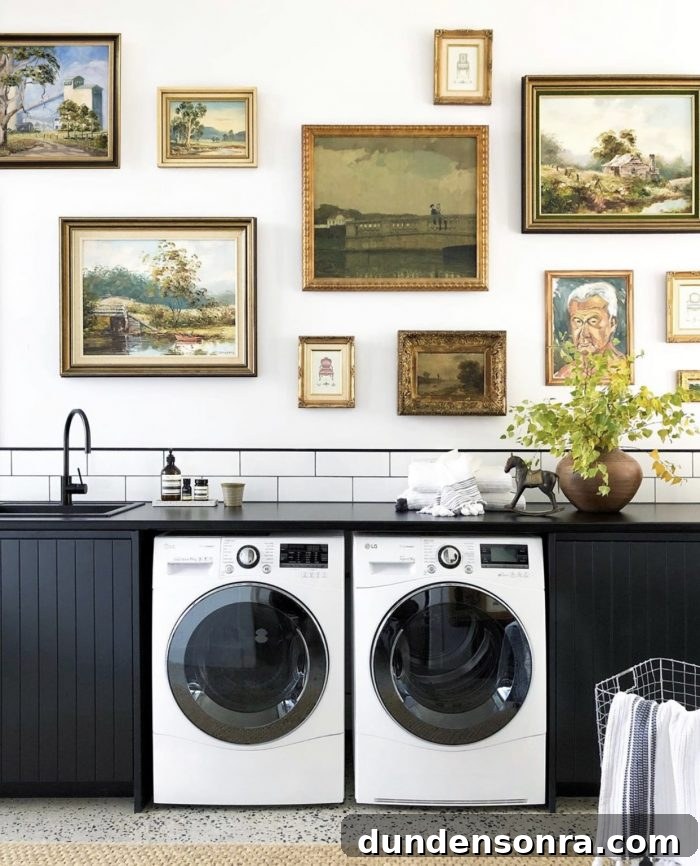
Photo via @jono.fleming
Select hanging hardware appropriate to each piece’s weight and frame. Read product weight limits and use anchors for heavier items.
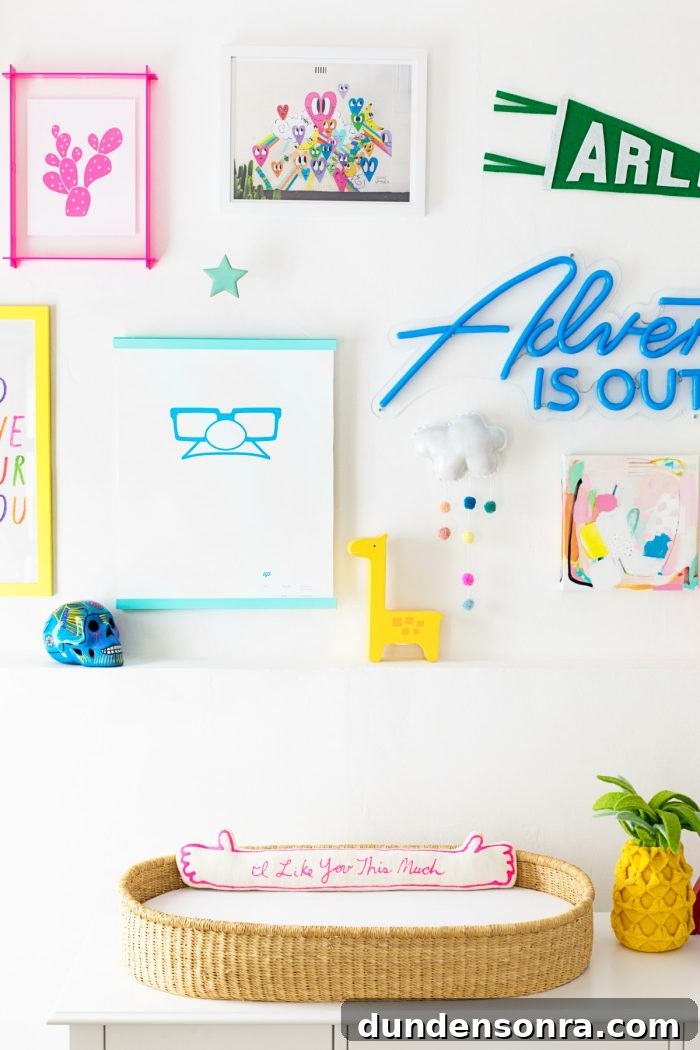
Photo by Jeff Mindell
Renting? Hang A Gallery Wall with NO Nails!
If you’re renting and want to avoid filling holes later, use heavy-duty adhesive hanging strips. They support a surprising amount of weight, are easy to apply and remove cleanly when it’s time to move out. For very heavy frames, consider removable picture hooks rated for higher weights or plan to patch small nail holes at move-out.
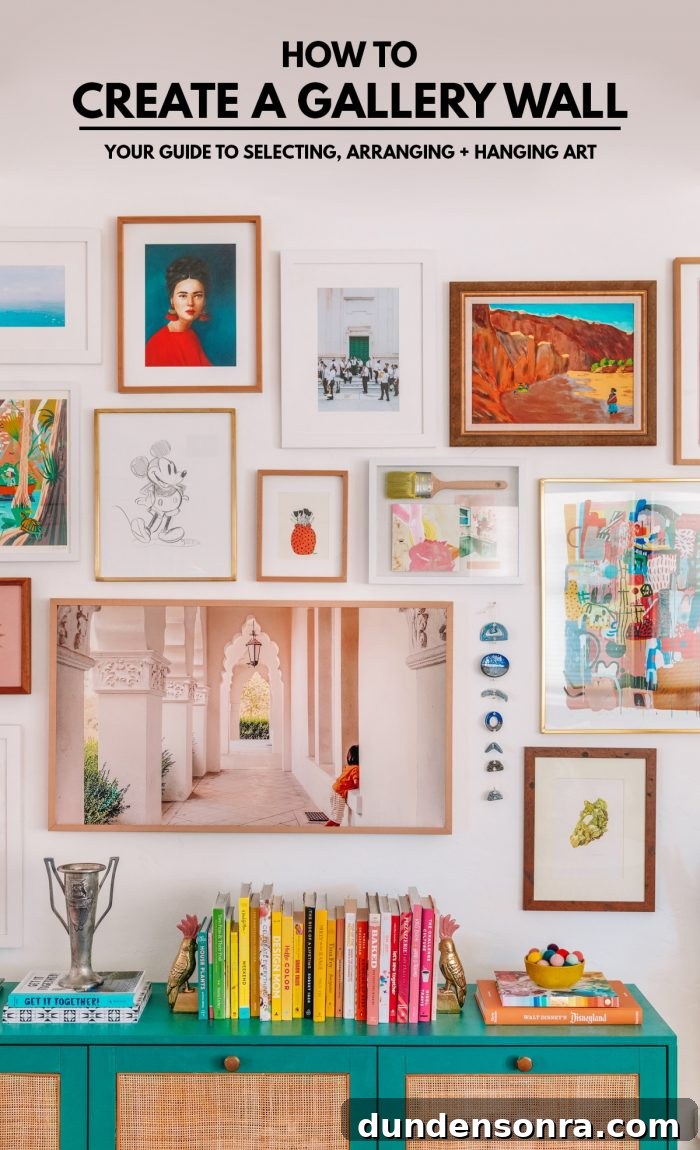
With a plan and a few key pieces, you can confidently create a gallery wall that feels curated, personal and balanced. Start with what you love, experiment with placement and enjoy the process of turning a blank wall into a meaningful display.